The Scoreboard Before the Digital Screen
The scoreboard before the digital screen turned rulings into public information. See how flip panels, chalkboards, and venue layouts shaped game-day understanding.
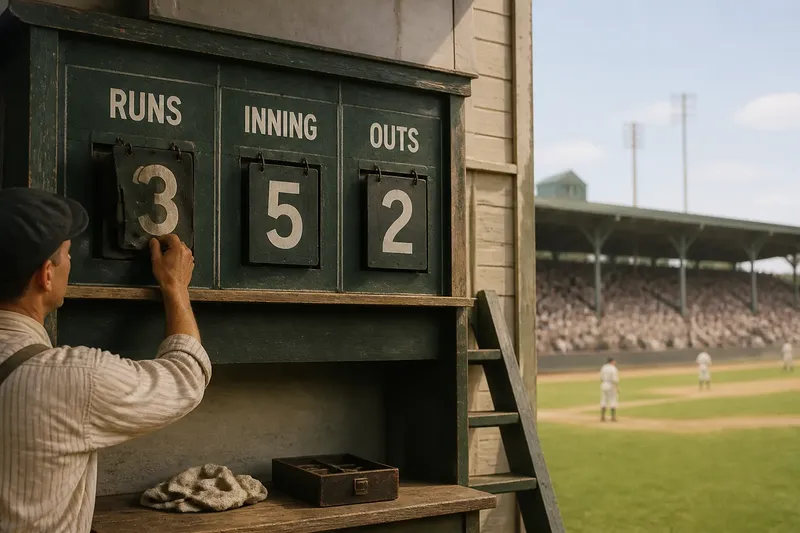
At a baseball ground, an attendant could flip a panel from one numeral to the next while spectators watched the inning unfold. The scoreboard before the digital screen made a ruling visible through a physical change: a card slid into a slot, a board turned, or chalk marked a fresh figure.
These displays were not one uniform historical system. Their materials and routines varied with the sport, venue, and available equipment. A surviving board is most revealing when its mechanism, labels, and position are read together.
Hand-changed scoreboards made each update visible
Simple boards used hinged numeral panels, removable cards, chalk, or markers that moved along a scale. Each method left a distinct trace: hinges suggest flipping, slots point to replaceable cards, and worn painted sections may indicate repeated movement over the same path.
In a compact gym, a modest board could sit near the court; in an open ground, larger lettering helped spectators across the stands distinguish the figures. This was less like a private notebook than a notice board in a shared hallway: the information mattered because people could see the same update together.
A manual display also made its limitations plain. If it had room for only a score and an inning, it could not explain every detail of a complicated contest. Its labels and columns show which parts of the game the venue considered essential to communicate.
Sport-specific labels reveal what spectators needed to follow
Different sports required different public records. A baseball board might include innings and outs; a court-sport display could distinguish sets or games; a race board might identify lanes, competitors, or laps. The score alone does not tell the whole story, and the extra labels show how a venue translated a sport’s rules into information for its crowd.
That translation also reflected local practice. A board’s terminology could make sense to regular spectators while leaving a newcomer unsure. When studying an old display, note unfamiliar abbreviations and compare them with the sport’s rules in the relevant period rather than assuming that every label had a universal meaning.
Imagine an invented community baseball ground with separate panels for runs, inning, and outs. An official confirms a run; the attendant changes the runs panel and leaves the other two alone. The expected visible result is a new total paired with the same inning and outs, so spectators can distinguish the scoring play from a change in the game’s sequence.
Attendants connected official decisions to public displays
Where a board was changed by hand, someone had to receive the information and alter the display. The particular arrangement depended on the venue: an attendant might work near an officials’ table or reach the board from a platform. Without a dated local record, a surviving mechanism cannot establish exactly who performed that task or how updates were authorized.
The distinction between a decision and its display matters. An official determined the state of play; the attendant’s job was to represent the confirmed information. A delay, mistaken panel, or unclear signal could make the public display disagree with what spectators believed they had seen.
For historical interpretation, look for evidence tied to the specific place: photographs, venue records, inscriptions, or local accounts that identify the board and its use. A ladder or access hatch may suggest how a person reached the mechanism, but it does not by itself prove who operated it.
Placement and lettering shaped who could read the score
A scoreboard had to fit the sightlines of its venue. A low board might be easy to reach yet disappear behind spectators; a high one could be visible across a ground but harder to update. In a gym, nearby seats and overhead lighting created different constraints from those at an outdoor field.
Large, contrasting numerals helped viewers recognize a score quickly, while cramped labels could make the board difficult to interpret from a distance. More displays could address different viewing areas, but a board’s location should be understood from the building or ground around it, not from the object alone.
What can an old manual scoreboard tell you?
How were the figures changed?
Look for hinges, card slots, hooks, rails, chalk marks, and access points. If the mechanism shows repeated wear around a hinge, treat flipping as a plausible use; if the surface lacks such evidence, avoid assigning a specific operating method without supporting records.
Which parts of the game did the board display?
Record every visible label, column, and abbreviation, then identify the sport and the rules associated with the board’s documented period. If a label’s meaning is uncertain, preserve that uncertainty instead of translating it into a modern term by guesswork.
Could spectators across the venue see it?
Compare the board’s orientation with the stands, court, or field visible in photographs or site plans. If it faced only one seating area, infer a likely viewing priority rather than claiming it served the entire crowd.
Who may have updated the display?
Check for an attendant’s platform, hatch, ladder, or proximity to an officials’ area, and seek local records that name the operator. If the physical clues are inconclusive, describe how the board could be reached without stating who actually changed it.
Read the mechanism, labels, and setting together
The scoreboard before the digital screen was a public record assembled in view of the crowd, but its details belong to particular sports and places. Its panels show what information could be changed; its labels reveal what the venue chose to communicate; and its position hints at whose sightlines mattered.
When examining one, separate what the object demonstrates from what its setting only suggests. That distinction turns a familiar board into a more careful account of how a game’s official state became visible to spectators.